
What happens when global technology companies, investors, government leaders and African entrepreneurs sit in the same room to discuss the future of trade?
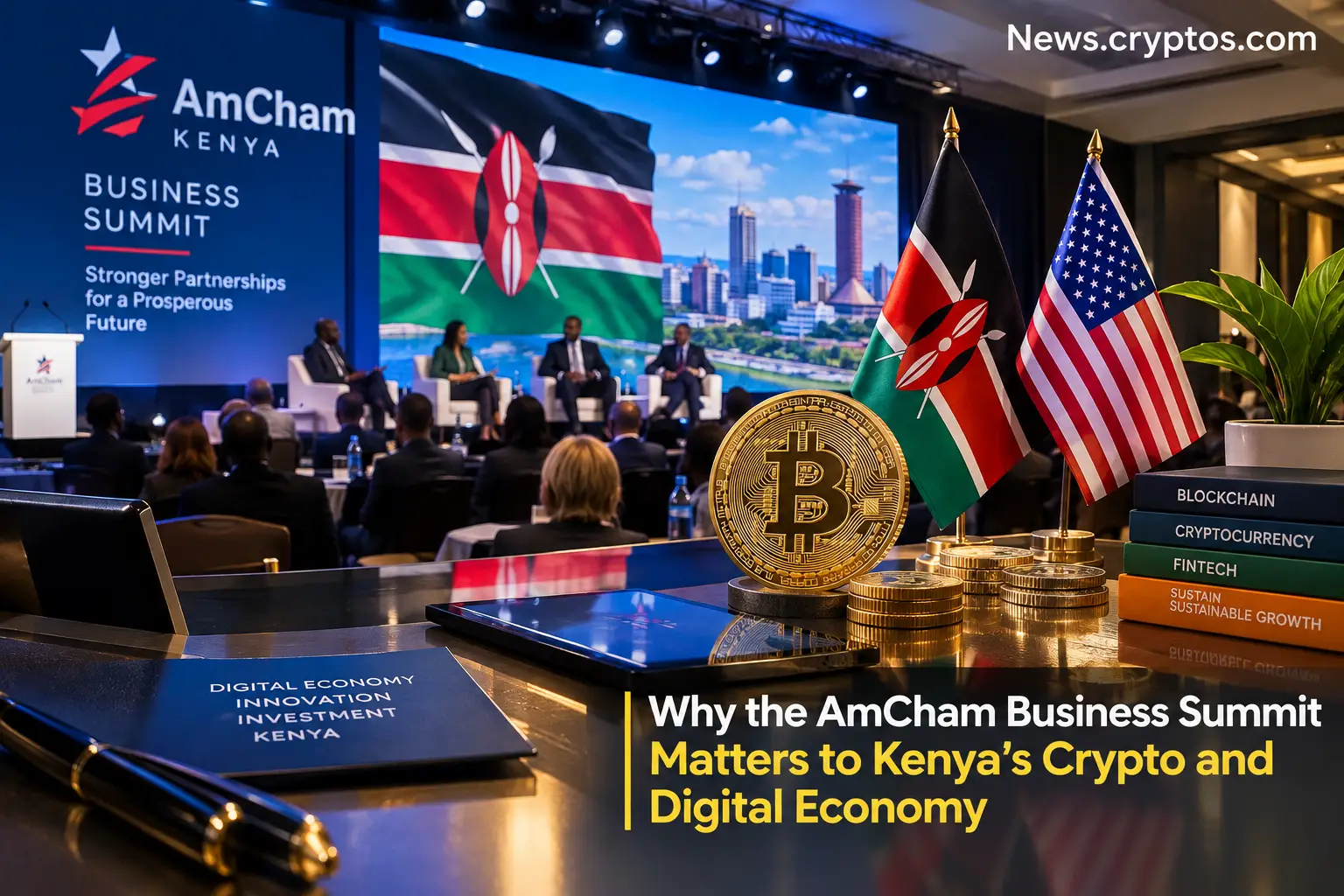
That was the bigger story behind the 2026 American Chamber of Commerce (AmCham) Business Summit, held in Nairobi on September 9–10.
At first glance, the summit may have appeared to be another high-level business gathering focused on investment, trade and diplomacy.
But for anyone following crypto, fintech, digital payments and Africa’s emerging digital economy, the conversations offered a much bigger picture.
The central question was not simply how Kenya can attract more investment.
It was how Kenya can become part of the infrastructure through which Africa trades, pays, finances businesses and moves capital.
Beyond cryptocurrency: the infrastructure opportunity
For years, much of the public conversation around crypto in Africa has focused on Bitcoin prices, stablecoins, exchanges and peer-to-peer trading.
Those remain important.
But the AmCham summit highlighted another part of the story: the infrastructure underneath the digital economy.
Discussions covered digital payments, artificial intelligence, cloud computing, data centres, cybersecurity, digital public infrastructure and regional digital transformation.
A blockchain-powered mobility-financing initiative involving Telecoin and Power Hive also demonstrated how blockchain technology is being explored for applications beyond cryptocurrency trading.
That distinction matters.
The next phase of digital finance may not be defined simply by people buying and selling digital assets. It could increasingly involve blockchain and digital financial infrastructure being incorporated into payments, financing, asset ownership and cross-border commerce.
Africa’s biggest opportunity may be cross-border trade
The African Continental Free Trade Area was another important theme at the summit.
AfCFTA is intended to create a much larger integrated African market, but moving goods across borders is only one part of the challenge.
Businesses also need to be able to invoice, receive payments, settle transactions and manage liquidity across different countries and currencies.
That is where the digital-finance conversation becomes particularly relevant to the crypto community.
Mobile money, fintech platforms, traditional payment networks, stablecoins, digital wallets and potentially blockchain-based settlement systems are all part of a rapidly evolving financial landscape.
The technology that ultimately dominates will depend on regulation, cost, reliability, interoperability and consumer adoption.
But the underlying demand is clear: African businesses need increasingly efficient ways to participate in regional and global commerce.
Kenya wants to be the digital gateway
The summit also reinforced Kenya’s ambition to position itself as a gateway to the wider African market.
More than 800 delegates from over 30 countries participated in the summit, with more than 500 B2B and B2G meetings reported by AmCham.
The event also featured major discussions around technology and investment, while significant U.S. investment announcements reinforced the country’s position as a regional commercial hub.
An $80 million Digital Realty data-centre investment in Nairobi was among the developments highlighted during the summit.
Why should a crypto audience care about a data centre?
Because digital finance ultimately depends on infrastructure.
Exchanges, payment platforms, wallets, AI systems, financial applications and blockchain networks all require connectivity, computing capacity, security and reliable data infrastructure.
The digital economy cannot exist in the cloud without the physical infrastructure underneath it.
From wallets to real-world assets
One of the more interesting developments discussed around the summit was the blockchain-powered mobility-financing initiative involving Telecoin and Power Hive.
The concept points towards an emerging area of digital finance: using technology to connect capital with real-world assets.
Electric vehicles and other productive assets can potentially become part of digitally managed financing ecosystems, creating new ways for investors and users to participate.
This is an important evolution in the conversation around blockchain.
Instead of asking only, “Can I buy cryptocurrency?”, the more consequential question becomes:
“Can digital infrastructure make it easier to finance, own, transfer and generate income from real-world assets?”
That is a question with implications far beyond the crypto industry.
The role of American technology
The summit also brought major American technology and financial companies into Kenya’s digital-economy conversation.
Companies and institutions represented across the programme included major players in technology, cloud computing and payments.
Their participation matters because Africa’s digital transformation will require partnerships between governments, local entrepreneurs and global technology providers.
For Kenya’s crypto and fintech communities, this creates an environment worth watching closely.
Regulation will determine what businesses can build.
Infrastructure will determine what can scale.
And payment interoperability will determine how easily digital businesses can operate across borders.
Why crypto entrepreneurs should pay attention
The biggest lesson from AmCham 2026 may therefore be that the digital economy is becoming increasingly interconnected.
Crypto cannot be viewed in isolation from fintech.
Fintech cannot be viewed in isolation from payments.
Payments cannot be viewed in isolation from AfCFTA.
And AfCFTA cannot be viewed in isolation from the infrastructure required to move money and information across borders.
That is why conversations happening at events such as AmCham matter to the African crypto community.
They reveal where governments, investors and multinational companies are directing attention and capital.
The opportunity for Africa
Africa does not have to reproduce every financial system developed elsewhere.
The continent has already demonstrated its ability to leapfrog traditional infrastructure through mobile money and digital financial services.
The next leap could involve an ecosystem combining mobile money, fintech, digital identity, artificial intelligence, blockchain, stablecoins, digital payments and regional trade infrastructure.
Whether that future becomes reality will depend on regulation, responsible innovation, consumer protection and the ability of African businesses to build solutions that solve real problems.
The AmCham Business Summit offered a glimpse into that larger transition.
For the crypto community, the takeaway is simple:
The future of digital assets may be bigger than crypto trading.
It could be about the infrastructure of African commerce itself.
And Kenya wants to be at the centre of it.