
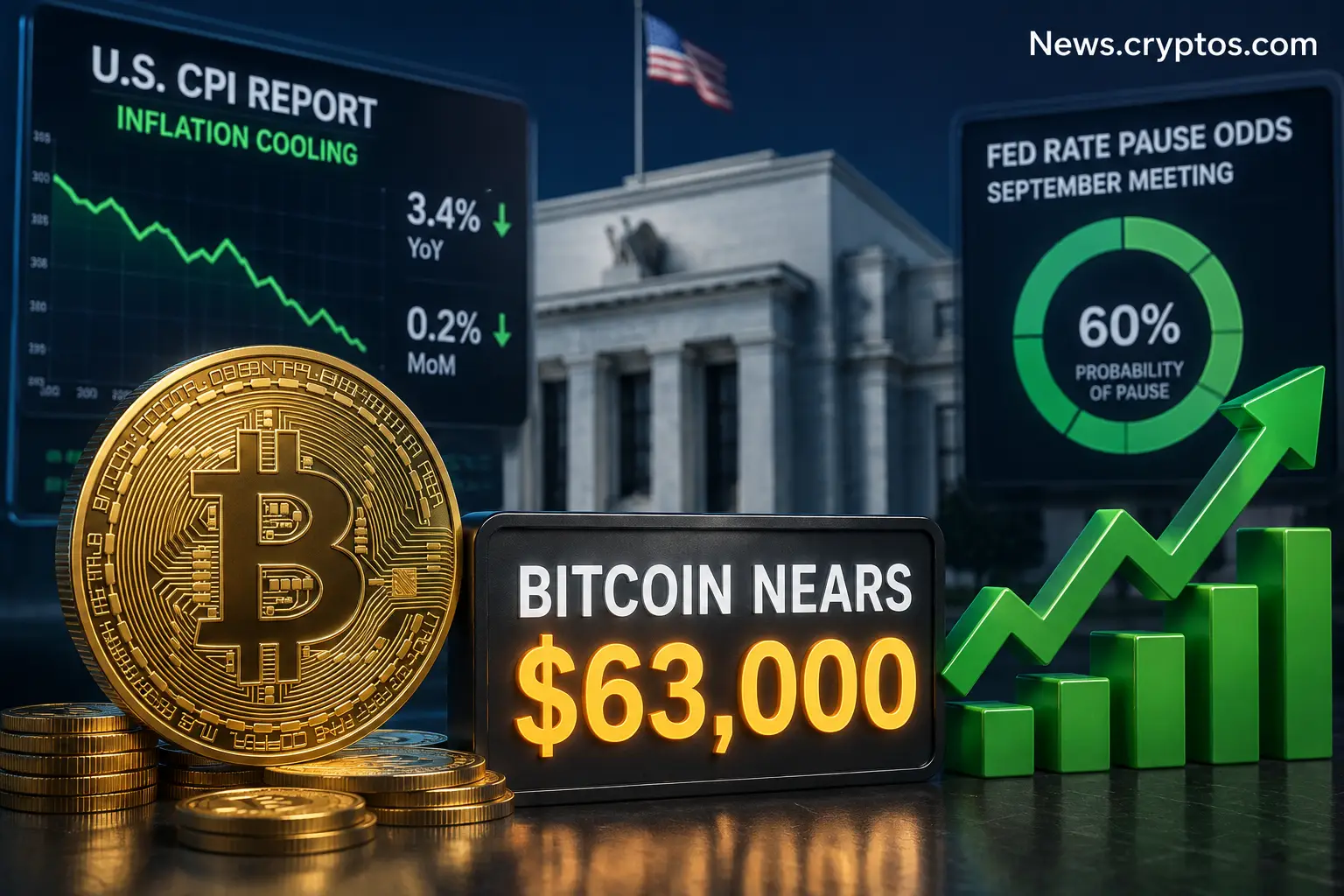
Bitcoin moved closer to the $63,000 level after the latest U.S. inflation report reinforced investor expectations that the Federal Reserve may leave interest rates unchanged at its September policy meeting. The cryptocurrency market reacted to the economic data as traders reassessed the outlook for monetary policy, with growing optimism that borrowing costs could remain steady in the near term.
The latest Consumer Price Index (CPI) figures showed that inflation continued to ease modestly, largely matching economists’ forecasts. Annual inflation slowed to 3.4%, down from the previous month’s reading, while monthly inflation increased only slightly. Core inflation, which excludes the more volatile food and energy sectors, also edged lower compared to the previous month, indicating that underlying price pressures are gradually cooling.
Following the release of the inflation data, financial markets adjusted their expectations for the Federal Reserve’s next policy decision. Traders increased their confidence that the central bank could maintain its current interest rate range during its September meeting rather than introducing another rate hike. Market pricing showed the probability of a pause climbing to roughly 60%, reflecting a notable shift in investor sentiment over recent weeks.
Bitcoin initially experienced volatility as investors digested the economic figures. Although prices briefly retreated below key resistance levels, the broader market viewed the inflation report as a positive signal for risk assets. Lower inflation generally reduces pressure on central banks to tighten monetary policy, creating a more favorable environment for assets such as cryptocurrencies, equities, and technology stocks.
Analysts note that Bitcoin remains highly sensitive to macroeconomic developments, particularly interest rate expectations in the United States. Higher interest rates often encourage investors to move capital toward lower-risk assets offering attractive yields, while stable or lower rates tend to improve liquidity and increase demand for higher-risk investments like digital assets. As a result, every major inflation report has become a closely watched event for cryptocurrency traders.
Despite the encouraging inflation data, market participants remain cautious. Economists point out that inflation still remains above the Federal Reserve’s long-term target, meaning policymakers are unlikely to declare victory over price pressures. Additional economic reports, including the upcoming Producer Price Index (PPI), labor market data, and future inflation readings, will likely play an important role in determining whether the Fed ultimately keeps rates unchanged or resumes tightening later in the year.
Technical analysts are also closely monitoring Bitcoin’s price action around the $63,000 level. This price zone has emerged as an important area of support and resistance in recent trading sessions. A sustained move above nearby resistance could strengthen bullish momentum and encourage additional buying interest, while failure to maintain current levels could trigger renewed selling pressure.
The improving inflation outlook has also supported broader financial markets. Lower inflation generally eases concerns about aggressive monetary tightening, allowing investors to focus more on corporate earnings, economic growth, and liquidity conditions. For cryptocurrency markets, this environment often translates into stronger institutional participation and increased capital inflows as investors seek higher-return opportunities.
Even so, analysts emphasize that Bitcoin’s longer-term direction will depend on several additional factors beyond inflation. These include institutional investment flows, spot Bitcoin ETF demand, global economic conditions, regulatory developments, and geopolitical events that continue to influence overall market sentiment. While the latest CPI report has improved short-term confidence, traders remain alert for further economic releases that could reshape expectations ahead of the Federal Reserve’s September meeting.
For now, the combination of easing inflation and increasing expectations for a pause in interest rate hikes has provided fresh optimism across the cryptocurrency market. If upcoming economic data continues to support a softer inflation trend, Bitcoin could benefit from renewed investor confidence as markets look ahead to the Federal Reserve’s next policy decision.
Source: Cointelegraph Edited by Sonarx