
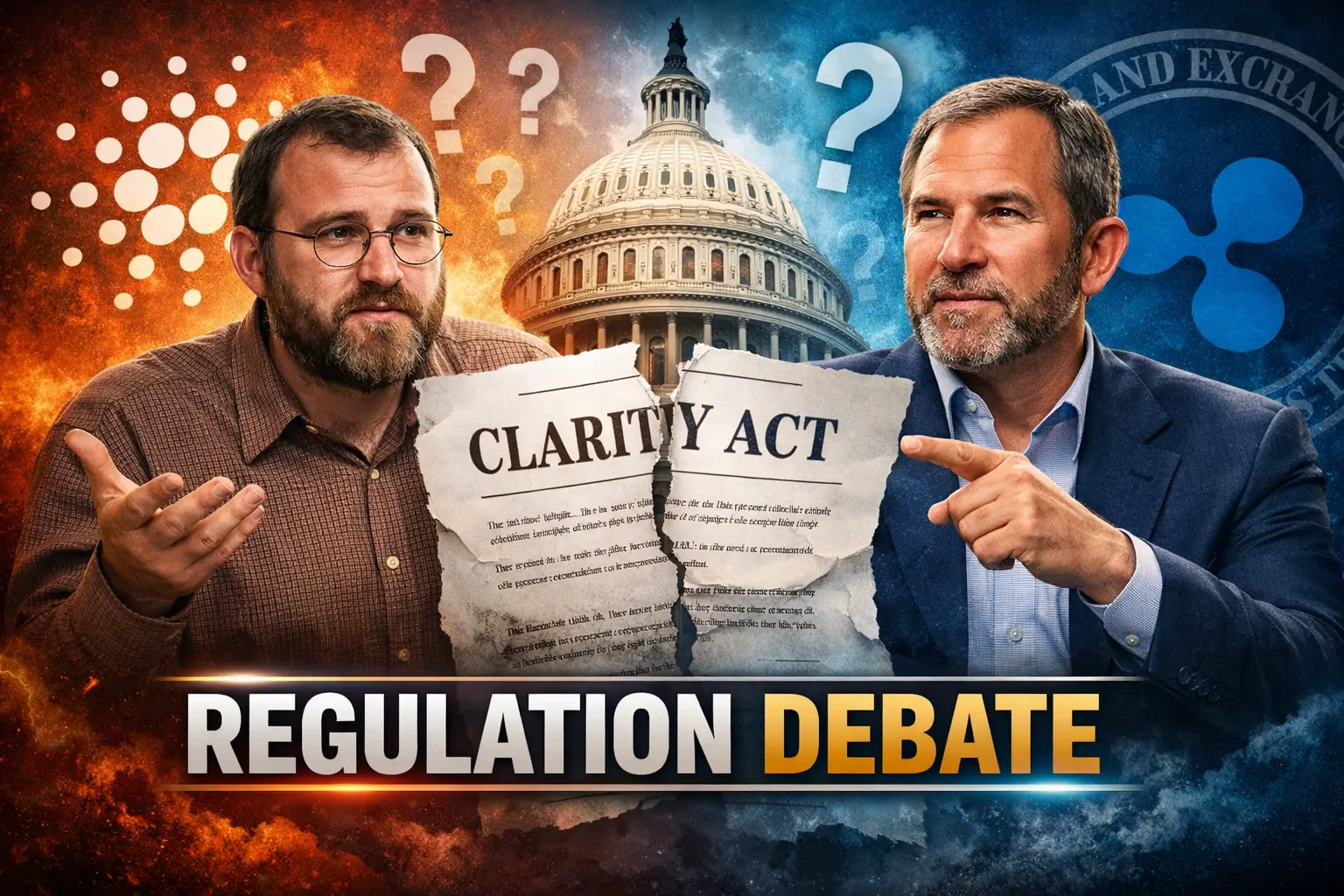
In a recent public discussion, Cardano founder Charles Hoskinson openly questioned Ripple CEO Brad Garlinghouse’s position on the proposed Digital Asset Market CLARITY Act, a U.S. legislative effort intended to bring clearer rules to the cryptocurrency industry. Hoskinson strongly disagreed with the idea that accepting an imperfect regulatory framework is better than having no clarity at all.
Garlinghouse had earlier suggested that even flawed regulation could be beneficial, arguing that the crypto sector has suffered long enough from uncertainty and inconsistent enforcement. In his view, partial clarity could provide businesses with a framework to operate within while improvements are made over time.
Hoskinson, however, challenged this reasoning. He warned that approving weak or poorly structured legislation could create long-term damage for the industry. According to him, laws that appear to offer clarity on the surface may actually reinforce regulatory overreach, particularly by agencies that have previously taken aggressive or hostile actions against crypto companies.
He further argued that rushing legislation simply to escape uncertainty could lock the industry into unfavorable rules that are difficult to reverse. Hoskinson emphasized that regulatory clarity should not come at the cost of innovation, decentralization, or fair treatment of blockchain projects. In his view, “bad clarity” may be worse than temporary ambiguity if it strengthens enforcement mechanisms that stifle growth.
The debate sparked significant attention across the crypto community, especially among Cardano supporters. Online discussions and engagement surged following Hoskinson’s remarks, reflecting growing frustration within the industry over how regulation is being approached in the United States. Despite the heightened interest, Cardano’s ADA token experienced short-term price weakness, briefly declining before settling into a relatively stable range.

Source: Santiment
This public disagreement highlights a deeper divide among crypto leaders regarding how best to handle regulation. While some favor gradual progress even if the framework is imperfect, others believe the industry should push back until lawmakers deliver comprehensive, balanced, and innovation-friendly policies.
Ultimately, the exchange underscores the ongoing struggle between regulatory certainty and regulatory quality — a challenge that continues to shape the future direction of the cryptocurrency market.
Source: Ambcrypto Edited by Sonarx